
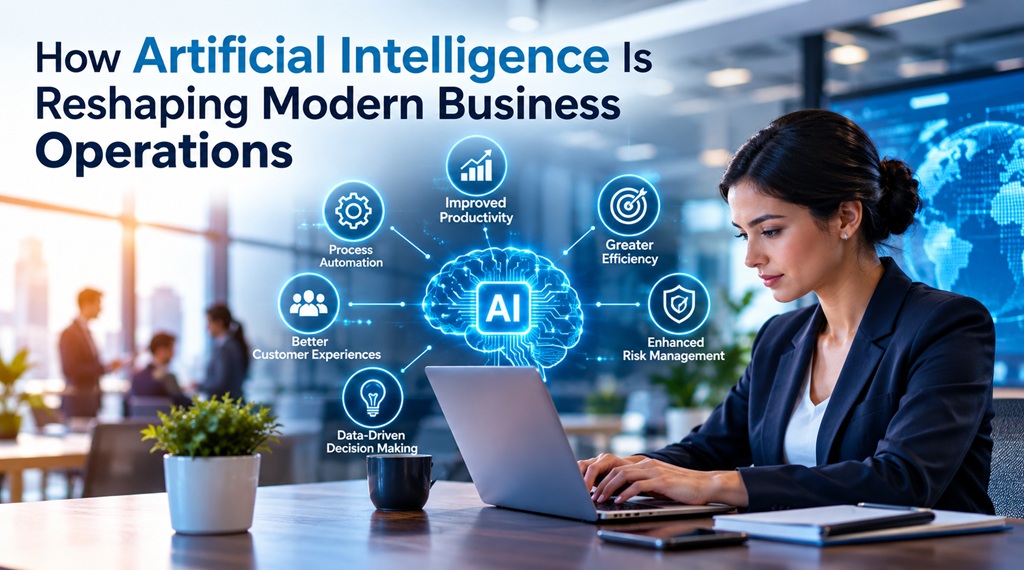
Artificial Intelligence (AI) is becoming recognized, and today, it has become an important element in the field of business management. AI in businesses has outgrown its experimentation phase and has already been implemented in various aspects such as data analysis, customer service, finance, logistics, quality control, and decision making. Generative AI is but one among the various forms of artificial intelligence which have brought about a change in business management. There are numerous other forms of AI that include machine learning, computer vision, natural language processing and predictive analytics that are currently being used by companies. This can be seen from the figures provided in the OECD statistics where the use of AI by companies rose from 14.2% in 2024 to 20.2% in 2025 from 8.7% in 2023.
Automation Is Moving into Core Workflows
The most apparent influence of AI on our lives is the automation of tedious tasks. In contrast to traditional rule-based computer programs, which need structured data, AI is capable of handling unstructured data and spotting patterns in large sets of data.
Common operational applications include:
- Financial Document Processing: Automates invoices, purchase orders and other financial documents to reduce manual work.
- Email and Request Classification: Categorize emails, service requests and customer inquiries for faster response handling.
- Demand Forecasting: Predicts the demand and inventories needed for effective inventory management.
- Contract Analysis: Analyses contracts and extracts the relevant clauses and terms.
- Anomaly Detection: Identifies unusual patterns in transactions and operational data for early risk detection.
- Computer Vision Inspection: Detects product defects and equipment issues through automated visual inspection.
- Document Generation: Creates summaries, reports, and routine business documents to accelerate administrative tasks.
Therefore, the importance of AI does not lie in replacing certain operations, it lies in connecting several steps of the operation into one single process. For example, an AI software program may identify the incoming request, classify it, collect the necessary information, formulate the response and finally assign it to the appropriate employee if human intervention is required.
AI Is Changing Decision-Making
Operations within businesses today rely heavily on quick understanding of huge amounts of data. AI could facilitate decision-making through recognizing relationships between certain phenomena, predicting probable outcomes, and highlighting possible patterns for the management to see. Predictive analytics could be used in supply chain management to predict demand changes and detect disruptions as well as to adjust inventory. Computer vision systems could be employed in manufacturing for defect detection and production control. In finance, artificial intelligence could be helpful in performing transaction analysis, risk assessments, compliance checks, and other tasks where the company is supposed to analyze huge amounts of data.
Moreover, financial institutions are looking at AI to detect fraud and financial crime. Studies conducted by the Bank for International Settlements have outlined how the current technologies of AI can help recognize complicated and coordinated patterns in the payment system data, which could be difficult to recognize through transaction-based methods. An analogous case can be seen in insurance fraud detection. According to the National Association of Insurance Commissioners, AI is being used in the underwriting process, claims processing, and fraud detection. AI-assisted claims assessment can analyze pictures, historical data, and more to detect any irregularities.
Customer Operations Are Becoming More Data-Driven
AI is also transforming the way businesses deal with their customers through the use of chatbots and virtual assistants in answering routine questions, summarizing customers’ backgrounds, sorting out service requests, and even providing information after office hours. Natural language technology makes it possible to study the feedback, reviews, discussions, and communication of customers to detect problems and optimize the service. Nevertheless, the use of AI technology doesn’t necessarily lead to a good customer experience, since bad training data, wrong answers, and incorrect automation may create additional problems. According to the National Association of Insurance Commissioners, large language models can produce accurate-seeming but wrong information.
Productivity Gains Depend on Implementation
According to the research carried out by the OECD, it is evident that generative AI has the potential to enhance performance for particular jobs. This is, however, contingent upon the job and the user experience involved. It thus takes more than just AI adoption to achieve success.
Implementation quality can be influenced by several factors:
- Data Quality: Incomplete or skewed data may negatively affect the model’s performance.
- Digital Infrastructure: There is a need for digital infrastructure that is suited for AI.
- Workforce Capability: The workforce should be capable of validating the outcomes generated by AI.
- Process Redesign: When workflow is engineered to ensure the proper demarcation of responsibility between humans and machines, AI functions more effectively.
- Measurement: Enterprises have to be able to differentiate between actual productivity gains and simply increased automation.
The OECD has recognized that connectivity, computing and data resources, skills and financing are critical facilitators for AI uptake, especially for SMEs.
Workforce Roles Are Evolving
The influence of AI on employment is a much more complicated picture than just an alternative scenario. As stated by the 2025 analysis of the International Labor Organization, about one quarter of the global workforce is engaged in professions where there is at least some level of risk from the use of generative AI. Yet, the conclusion reached by the organization is that the probability of transformation rather than elimination of jobs is higher.
It means that for organizations, the planning of workers is also a part of AI strategy. The workers may actually find themselves spending more time performing activities that involve handling of exceptions, decision-making, relationship management, problem-solving, and oversight and less in performing activities that are information-processing oriented. This will also give rise to the need for AI literacy among workers to know when not to trust AI results.
Governance Is Becoming an Operational Requirement
As AI becomes more central to decision-making in the business environment, corporations are becoming more conscious of the issues of governance, transparency, privacy, security, and accountability. The AI Risk Management Framework, which has been developed by NIST, is a systematic way to manage AI risks throughout the process of design, development, deployment, and assessment. The Generative AI Profile highlights the risks related to generative AI systems. The regulation of enterprise practices is another trend in AI. In the EU, the AI Act is being rolled out gradually. Other requirements are set for implementation on later dates. The implication is that the regulation of AI is becoming increasingly interwoven with regular activities rather than viewed purely as an IT issue.
The Strategic Role of AI in Business Operations
Long-term importance of AI in business operations would be due to the integration of automation, analysis, and decision-making into a single system. Firms become more capable of using AI in order to move from retroactive analysis to forecasting and even prevention in certain cases. However, it does not mean that implementation itself can lead to improved performance of the firm. As per the OECD study, there is no equal level of implementation among different companies, and productivity depends on multiple factors.
This principle is also valid because market analysis is just one part of the wider system of market intelligence employed to track technology and industry trends. Indeed, this type of research may reveal many important things about developing events and market forces at work. Still, the accuracy of business decisions may become higher if this type of information is supplemented by information about the company’s own performance, achieved results, risks, and even particular client demands.
Conclusion
AI is revolutionizing modern organizations by redefining the way information is processed, automation is performed, risk management is conducted, customer services are delivered, and decision-making is made through its use in the insurance fraud detection market. It has been found that the effectiveness of AI lies more in the way organizations can integrate this technology into their operations rather than just installing the technology itself. This involves making sure that the application of AI technologies is aligned with organizational goals, data, people, and workflows.
According to Pristine Market Insights, the new operating model, thus, is not only one that aims at replacing people with machines, but one that seeks to build a system where algorithms do the heavy lifting of large volumes of analysis and repetitive work while the employees contribute the element of expertise, judgment, supervision, and responsibility. As more companies adopt AI, those companies that have effective AI programs, quality data, qualified employees, well-defined performance targets, and proper governance models in place would be in a much better position to evaluate the practicality of this technology.
This article is written by Teja Kurane. He is a research analyst at Pristine Market Insights, focusing on artificial intelligence, digital transformation, and emerging business technologies. Teja explores how AI-driven solutions are changing business operations, improving efficiency, supporting data-informed decisions, and helping organizations adapt to evolving customer expectations and increasingly technology-driven markets.