
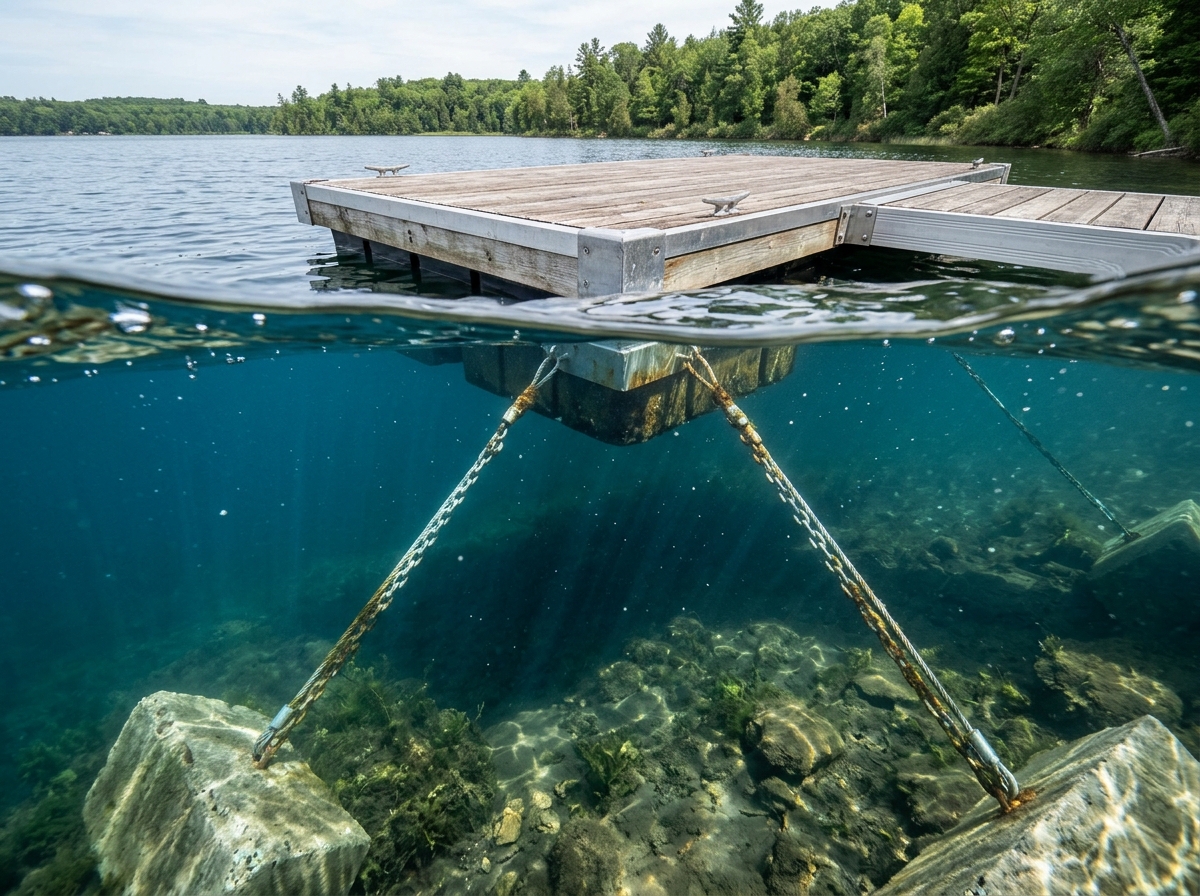
Deep water creates a different set of challenges for floating dock installation. Unlike shallow areas where contractors can often secure structures with driven piles, deeper locations may require underwater anchors, longer cables, and specialized equipment. The right anchoring method keeps a dock from drifting while allowing it to rise and fall with changing water levels.
Concrete Deadweight Anchors for Deep Lakebeds
Concrete deadweight anchors are commonly used where driving piles is impractical. These heavy blocks rest on the lakebed and resist movement through their submerged weight and friction against the bottom. Floating dock contractors connect them to the dock using chains or cables arranged to accommodate water movement. Anchor size depends on the dock’s dimensions, expected wind forces, water depth, and bottom conditions. Soft mud provides less resistance than firm gravel, and concrete weighs less underwater because of buoyancy. Contractors account for these factors instead of assuming that any heavy block will hold a floating structure securely.
How Do Helical Anchors Work Underwater?
Helical anchors resemble large steel screws that contractors install into suitable soil beneath the water. Their spiral plates develop resistance through the surrounding ground, allowing them to withstand pulling forces without relying entirely on weight.
Installation requires specialized equipment and knowledge of the lakebed material. Dense rock, loose debris, or unsuitable sediment can prevent proper placement. Professional boat dock builders may recommend helical anchors for locations where soil conditions support their use and the required holding capacity can be verified.
Unlike concrete blocks, helical systems depend heavily on soil strength and installation depth. Contractors must confirm that the anchor can withstand the expected loads before connecting it to a floating dock.
Cable and Chain Systems Allow Controlled Movement
An underwater anchor is only one part of the installation. Cables and chains transfer forces between the dock and its holding points, keeping the platform positioned while allowing vertical movement.
Steel cables provide tensile strength with relatively little stretch, while chains add weight and can help accommodate changing angles. Designers often use angled anchor lines extending away from different sides of the dock to resist movement in multiple directions.
Line length needs careful calculation. Excessively short connections can lift anchors or overload attachment points as water rises. Too much slack allows unwanted drifting, which may damage boats, gangways, or nearby structures.
What Makes Deep-Water Anchoring More Complicated?
Greater depth increases the distance between the floating platform and its anchors. Longer lines introduce additional movement, making anchor placement and cable angles more important. Wind exposure, wave height, and current also influence the loads acting on the system. Water-level changes add another consideration. Reservoirs may fluctuate considerably between seasons, requiring connections that remain effective at both high and low elevations. Experienced contractors evaluate these conditions before selecting anchor positions and attachment hardware. Installation access can be difficult as well. Larger anchors may require barges, lifting equipment, or professional divers to position and inspect components below the surface.
Can Aluminum Floating Docks Use Different Anchoring Methods?
Aluminum boat docks can accommodate several anchoring arrangements, provided the frame and attachment points are designed for the expected forces. Their lighter construction can reduce the structure’s overall weight, although wind, waves, and boat movement still create substantial horizontal loads.
Reinforced brackets and properly designed connection points help transfer those forces without damaging the frame. Directly attaching heavy anchor lines to unsuitable framing members can cause distortion or fatigue damage over time.
Material compatibility matters underwater. Stainless steel, galvanized components, and aluminum require suitable separation or protective measures where galvanic corrosion is possible.
Why the Lakebed Determines Which Anchor Works Best
Rock, sand, clay, and silt behave differently under pulling loads. A concrete block may slide across a smooth rocky surface, while a screw-type anchor may struggle to penetrate hard material. Soft sediment can allow certain anchors to sink or shift if contractors underestimate the required capacity.
Site assessments help identify these limitations. Depending on conditions, specialists may consider engineered rock anchors, embedded systems, or combinations of anchoring methods. No single arrangement works equally well across all deep-water locations.
Finding Contractors Who Understand Deep-Water Dock Installation
Searching for dock builders near me can help property owners locate companies familiar with local lake conditions. However, deep-water projects require more than standard dock assembly experience. Contractors should explain their anchoring recommendations, installation methods, inspection requirements, and how the system will handle seasonal water changes.
For waterfront properties requiring a dependable floating dock setup, Bar H Solutions offers aluminum dock systems along with design and installation services. Its team can help property owners evaluate dock configurations and site conditions, including the anchoring considerations involved in placing floating structures over deeper water.