
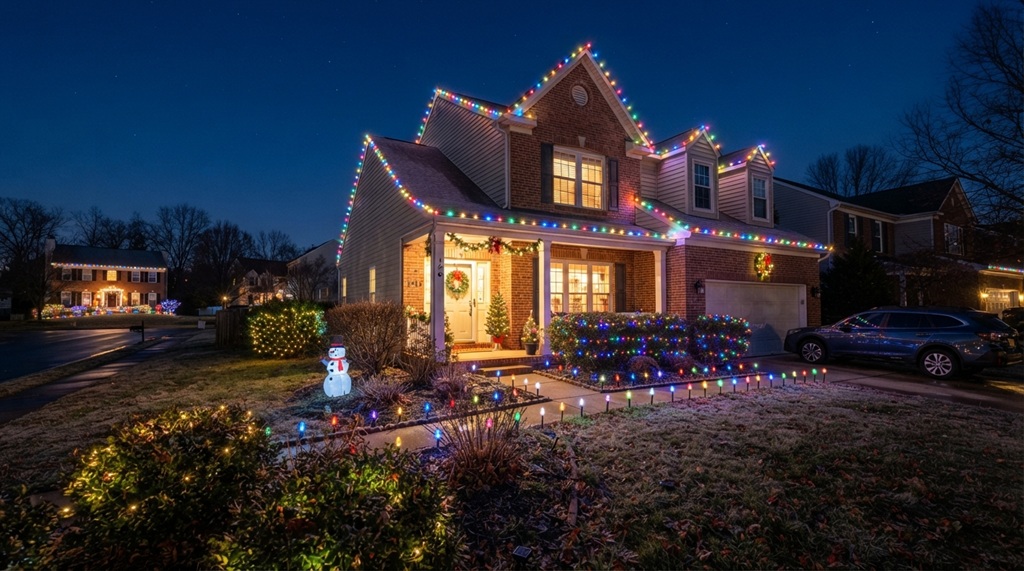
Let’s be honest—decking out your Maryland home for the holidays can get expensive fast. Between the strands, the timers, the clips, and the extension cords, costs add up before you even plug anything in. But you don’t need a six-figure light show to make your neighborhood stop and stare. With the right strategy, you can create a cozy, festive display that looks expensive without actually being expensive. This guide walks you through the best ways to find budget outdoor Christmas lights maryland residents can rely on, covering what to buy, where to skimp, and how to avoid the rookie mistakes that waste money every December.
Key Takeaways
- LED string lights cost more upfront but save significant money on energy and replacements compared to incandescent bulbs—especially over Maryland’s long winter nights.
- Timers and smart plugs are cheap tools that cut electricity waste dramatically, paying for themselves within the first season.
- For permanent or difficult-to-reach installations, investing slightly more in commercial-grade or higher-quality lights prevents dangerous and costly mid-season failures.
- Maryland’s winter weather (ice, snow, and wind) demands lights with at least IP44 weather resistance; don’t risk indoor-rated lights outdoors.
- Buying during post-Christmas sales and checking local hardware stores for clearance offers the best deals for next year’s display.
Why Your Choice of Lights Matters More Than the Quantity
Before you start comparing price tags, step back and think about what actually creates visual impact. It’s not the number of strands you buy—it’s how you use them. A single, well-placed strand of warm white lights outlining your roofline looks far more intentional than five tangled, multi-colored strands haphazardly draped over bushes. In Maryland, where many homes have varied architecture from brick colonials to Cape Cods, emphasizing clean lines—rooflines, windows, and doorways—creates a professional look that doesn’t require a massive investment.
Focusing on quality over quantity is your first money-saving move. Instead of buying the cheapest possible product, calculate your total cost of ownership. This includes the initial purchase price, the electricity to run them for 30–45 nights, and the likelihood of needing replacements next year. When you factor in those three elements, the “cheap” option often becomes the most expensive one.
LED vs. Incandescent: The Real Math
Here’s where informed decisions save the most money. Incandescent mini lights use about 0.4 watts per bulb. An LED mini light uses about 0.04 watts—roughly 90% less electricity. While a 100-bulb incandescent strand might cost $5 and an LED strand might cost $12, the LED strand will save you roughly $10–$15 in electricity over a single 40-day holiday season in Maryland, depending on your utility rates. The LED bulbs also last up to 25 times longer. When you do the math, LEDs are the clear winner for anything you plan to leave on for more than a couple of evenings.
Pro Tip: Look for “flicker-free” LEDs. Cheaper LED strands can sometimes have a subtle strobing effect that some people find distracting, especially when using cameras or video.
Weatherproofing: The Non-Negotiable for Maryland Winters
Maryland weather is unpredictable. You might see 60°F in early December and then a freezing rain storm by Christmas Eve. Your lights need to handle that swing. Here’s the critical rule: never use indoor-rated lights outdoors. Look for the “UL Listed for Outdoor Use” mark on the packaging. This means the lights meet specific safety standards for moisture and temperature resistance.
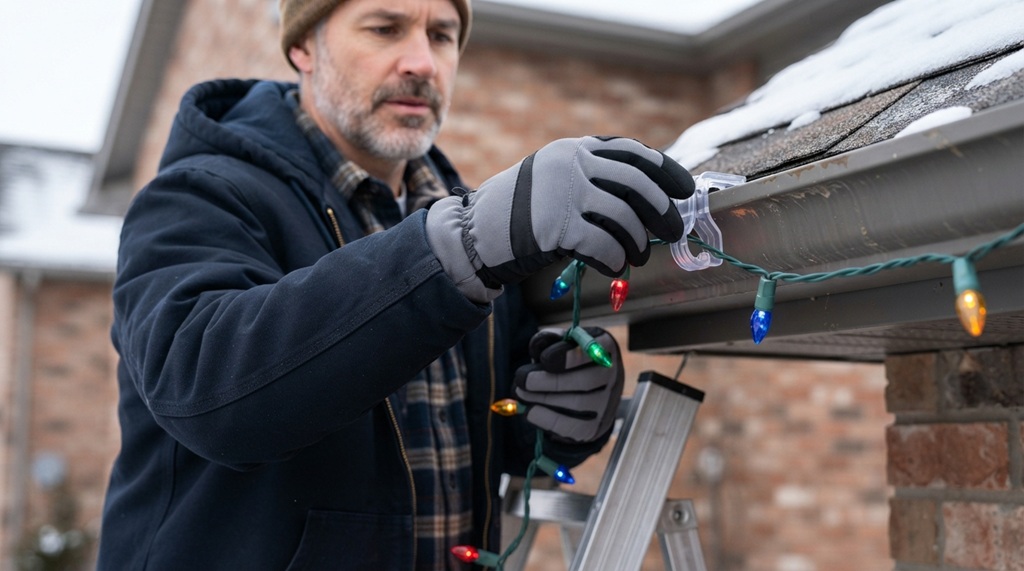
Pay close attention to the connection between the plug and the socket. Outdoor-rated lights have a rubber gasket that seals the connection when you plug them together. If you’re connecting multiple strands end-to-end, ensure those connectors are dry and clean before connecting them, and consider using a light socket cover for the female end of your strings to keep rain and snow out. Also, avoid hanging lights on metal gutters without clips—metal conducts electricity and can damage wiring over time through sharp edges.
Assessing Quality: What to Look for in a “Budget” Strand
Not all budget lights are created equal. Two strands at the same price can have wildly different build qualities. Here’s a quick checklist to assess a strand in the store or online before you buy:
- Wire Gauge: Check if the wire feels thick and has slight flexibility. Very thin, brittle wire is a sign of poor quality and can break during installation.
- Connection Ends: Look for molded, thick rubber connectors instead of flat, flimsy plastic ones. Molded connectors are less likely to crack in freezing temperatures.
- Bulb Seating: Ensure LED bulbs are securely seated in their sockets. Wobbly bulbs cause short circuits and flickering.
- Fuse Access: A small door covering a replaceable fuse in the plug head is a sign of quality—it allows you to fix a strand instead of throwing it away.
If you’re looking for reliable yet affordable options, many homeowners in the state start their search by checking local roundups of budget outdoor christmas lights maryland shoppers have found useful, which often includes specific retailer recommendations and current deals that have been vetted for the local climate.
Choosing the Right Lights for Your Home’s Architectural Style
Selecting the right outdoor Christmas lights requires balancing purchase price with your home’s architectural aesthetic, as different bulb styles serve distinct design purposes. Large C9 LED bulbs deliver sharp, classic outlines along rooflines and gables, while mid-sized C6 or mini string lights wrap smoothly around porch pillars, railings, and entryway greenery. If you want to maximize visual impact on a budget, take design cues from iconic East Coast neighborhood displays featured in our dyker heights christmas lights 2026 guide: Streets and directions, where strategic layering and high-density focal points create a spectacular luxury look without excessive effort. Matching bulb scale, warmth, and spacing to your facade ensures a polished, professional finish that enhances your home’s seasonal curb appeal.
Mini LED String Lights
These are the workhorses of budget decorating. They are lightweight, flexible, and easy to drape on shrubs, wrap around columns, or outline windows. They are perfect for adding a subtle sparkle. For Maryland’s wind and snow, they’re low-profile and don’t catch the wind like larger bulbs. They are also the safest bet for stringing across large distances due to their low energy draw.
C9 and C7 LED Bulbs
These larger bulbs (the traditional “big bulb” size) are ideal for rooflines and driveways. C9s are the larger of the two. They provide a more classic, bold glow. While they cost a bit more per strand than mini lights, their durability and visual impact are worth the extra dollar per strand. Use these if you want the traditional holiday look without constantly replacing bulbs.
LED Icicle Lights
Icicle lights are great for hanging along gutters to create a “frozen” effect. However, they can be tricky for budget shoppers. The drops can tangle easily, and if one drop stops working, it can break the circuit. Buy these only from reputable brands and check the warranty. In Maryland’s freeze-thaw cycles, the plastic drops can become brittle, so investing a little more in thicker plastic is wise.
Net Lights for Shrubs
If you have large bushes or hedges, net lights are a massive time-saver. They look neat and instantly polished without the effort of weaving strands through branches. However, they aren’t flexible—they only fit the size specified on the box. Measure your bushes before buying to avoid the frustration of a net that’s too small or too large.
Smart Timers and Power Strips: The Hidden Budget Savers
It’s easy to forget to turn your lights off before you go to bed. That’s wasted electricity, which directly works against your budget goals. An old-school mechanical timer costs about $10 and can be set to turn your lights on at dusk and off at midnight. This automation saves you from paying for hours of unneeded illumination.
For a slight step up, consider a smart plug. These connect to your home Wi-Fi and allow you to control your lights via a smartphone app. While they cost a bit more ($15–$25), they offer more flexibility—you can turn your lights on and off remotely if your schedule changes, and some even integrate with voice assistants like Alexa or Google Home, making it easy to say, “Turn on the porch lights,” without getting off the couch.
A Money-Saving Wiring Rule
Don’t overload your circuits. Most standard household circuits handle 15 amps. A typical string of 100 LED mini lights draws about 0.03 amps. You can safely connect up to 50 strands together (though it’s better to be conservative and use fewer). However, incandescent strands draw much more (around 0.33 amps), meaning you can only safely connect about three strands before you risk tripping a breaker. Since tripping a breaker cuts power to your house—or worse—it’s worth the extra socket to separate your loads.
Practical Mistakes to Avoid This Season
Every year, well-intentioned DIYers make the same mistakes, leading to broken lights and wasted cash. Here is the insider list of what not to do:
- Using indoor staples: Never use metal staples to secure wires. They can cut the insulation and create a fire hazard. Spring clips or gutter hooks are a worthwhile investment of a few dollars.
- Connecting incandescent and LED: Don’t string incandescent and LED lights together on the same circuit. The higher current of the incandescent set can damage the lower-wattage LEDs.
- Overtightening bulbs: When replacing bulbs, snug is good—tight is a mistake. Over-tightening can crack the base and ruin the socket.
- Pulling on the wire to disconnect: Always pull on the plug head itself, never the wire. Yanking on the wire loosens the internal connections and causes short circuits.
Where to Shop Smart in Maryland
Where you buy matters just as much as what you buy. While big-box retailers have the most significant selection, they often sell “entry-level” models specifically priced to hit a low number. These are fine for temporary displays, but you might be replacing them next year. Do not count out the seasonal “Christmas light stores” that pop up in shopping centers—they often carry professional-grade products at wholesale-friendly prices. Local Ace Hardware and True Value stores typically stock a good middle ground, offering brands like GE and Philips that balance affordability with reliability.
Don’t overlook the clearance rack. The day after Christmas is the official start of the budget decorator’s new year. You can find LED strands for 50–75% off. Buy for next year now, store them properly in dry, labeled bins, and you’ll be ahead of the curve—and the budget—when next December rolls around.
Frequently Asked Questions
Are LED lights really worth the higher upfront cost in Maryland?
Yes. Despite the higher initial price, LEDs use roughly 80–90% less electricity than incandescent bulbs. They also last significantly longer, making them better suited for Maryland’s cold, wet weather. You will recover the cost difference in energy savings within the first season or two.
How many strands can I safely connect together?
It is generally safe to connect up to 50 strands of LED mini lights (with 100 bulbs each) and up to 3 strands of incandescent mini lights (with 100 bulbs each). Always check the package for specific recommendations and avoid overloading your home’s electrical circuits.
What does “IP44” or “IP65” mean on light packaging?
It’s an Ingress Protection rating. The first digit indicates solid particle protection, and the second digit indicates liquid protection. For outdoor holiday lights, you want a rating of at least IP44, which means protected against splashing water from any direction—essential for Maryland rain and snow. IP65 is fully dust-tight and protected against low-pressure water jets.
Can I leave LED holiday lights on all night?
You can, but you shouldn’t for budget reasons. While LEDs are safer and cooler than incandescents, leaving them on for 12 hours instead of 6 hours doubles your energy consumption. Use a timer to keep them on for 4–6 hours and you’ll cut your seasonal energy bill in half.
How do I store my lights to make them last longer?
Wrap strands loosely around a piece of cardboard or a purpose-made storage reel. Avoid wrapping tightly around your elbow, which stretches out the wires. Store them in a cool, dry place in a sealed box to prevent rodents from chewing on the wiring.
Conclusion
Choosing budget outdoor Christmas lights in Maryland is about strategic planning, not just picking the lowest price tag. By opting for LEDs, prioritizing weatherproofing, using timers, and buying at the right time, you can build a stunning display that respects both your wallet and your safety. Focus your spending on the lines that matter most—your roofline and entryway—and use fewer, better-quality lights rather than a tangled mess of cheap ones. Start with a plan, measure your space, and shop smart. With these tips, you’ll avoid the usual holiday headaches and have your home glowing beautifully throughout the season without the inflated electricity bill.